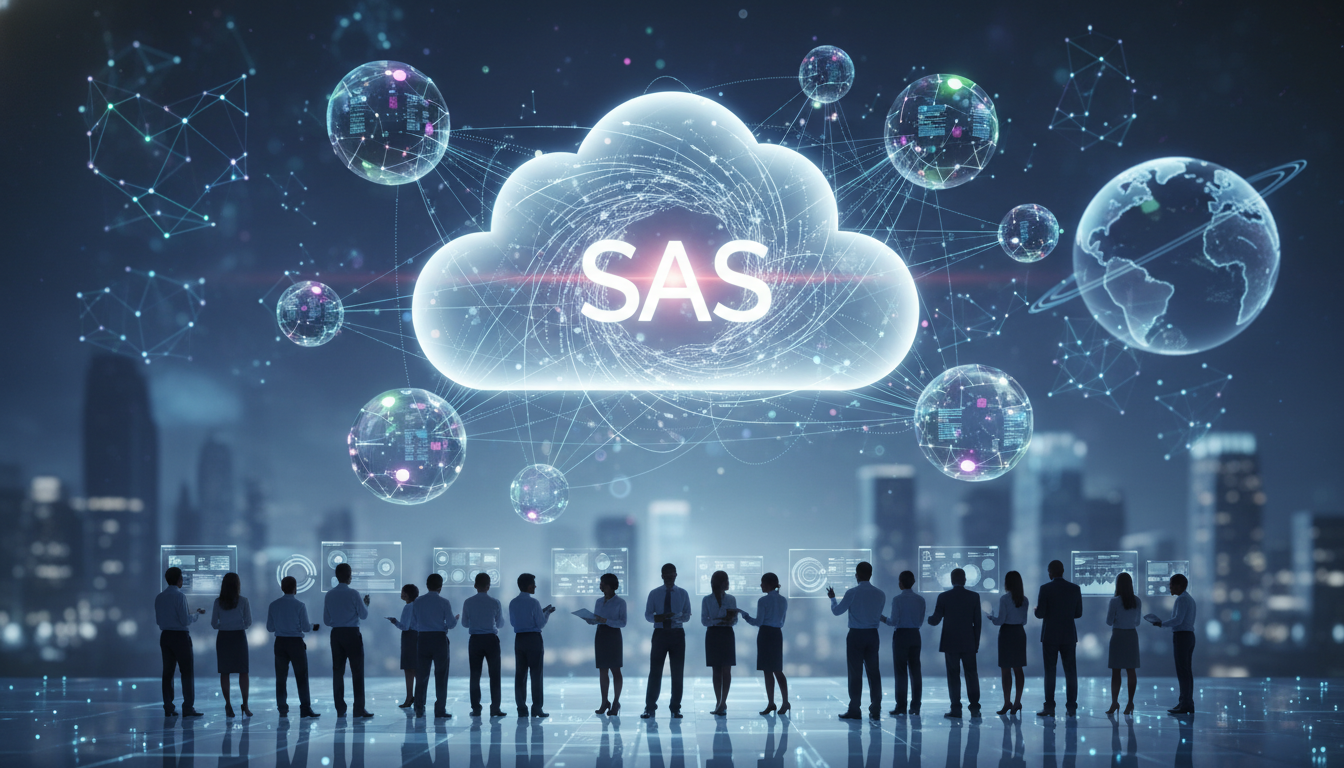
Decentralized Software as a Service (DSaaS) is a next-generation cloud computing model that delivers software applications over a peer-to-peer (P2P) blockchain network rather than through centralized servers owned by a single corporate entity. By leveraging Web3 technologies, smart contracts, distributed ledgers, and cryptographic security, DSaaS eliminates single points of failure, granting users absolute data sovereignty and enhanced privacy. As a paradigm shift from traditional Web2 cloud infrastructure, Decentralized SaaS transforms how decentralized applications (dApps) are hosted, monetized, and governed, replacing traditional subscription models with tokenomics and empowering users through Decentralized Autonomous Organizations (DAOs).
Quick Summary & Key Takeaways
- No Central Authority: Unlike traditional SaaS (hosted on AWS or Google Cloud), DSaaS operates on distributed nodes globally, meaning no single company controls your data or application uptime.
- Enhanced Cryptographic Security: Data is fragmented, encrypted, and stored across multiple nodes. Breaching a DSaaS platform requires compromising the entire blockchain network.
- Data Ownership: Users retain their private keys, meaning they truly own their data. The software provider cannot sell, mine, or arbitrarily censor user information.
- Token-Based Economics: Subscriptions are often handled via micro-transactions using cryptocurrency or utility tokens, allowing for “pay-as-you-go” models without traditional credit card processing.
- Censorship Resistance: Because the infrastructure is distributed globally, DSaaS platforms are highly resistant to localized server outages, government censorship, and corporate de-platforming.
Understanding the Evolution: From Traditional SaaS to DSaaS
To truly grasp the concept of Decentralized SaaS, we must first understand the foundation it is built upon. For the past two decades, the Software as a Service (SaaS) model has dominated the tech industry. Companies like Salesforce, Google Workspace, and Slack revolutionized business operations by moving software from local hard drives to the cloud. However, this Web2 model relies heavily on centralized architecture.
In a centralized SaaS environment, all user data, backend logic, and application hosting reside on servers owned by a few tech giants. This creates a massive target for cybercriminals, leads to frequent data breaches, and forces users to trust third-party corporations with their most sensitive intellectual property. Furthermore, if the centralized server experiences an outage, millions of users instantly lose access to their critical business tools.
DSaaS (Decentralized Software as a Service) emerges as the Web3 solution to these vulnerabilities. By utilizing blockchain technology and decentralized storage protocols like the InterPlanetary File System (IPFS), DSaaS distributes the software’s backend across thousands of independent nodes. This means the application is essentially unkillable, highly secure, and operates without a central point of failure. In my experience auditing enterprise cloud migrations, the shift from centralized data silos to trustless, distributed networks represents the most significant architectural evolution since the invention of the cloud itself.
How Does Decentralized SaaS Work? The Core Architecture
The architecture of a DSaaS platform is fundamentally different from a traditional web application. It relies on a stack of decentralized technologies working in unison to provide a seamless user experience while maintaining absolute security and transparency.
1. Smart Contracts Replace Traditional Backend Logic
In traditional SaaS, proprietary backend code dictates how the software functions. In DSaaS, this logic is executed through smart contracts. These are self-executing contracts with the terms of the agreement directly written into lines of code deployed on a blockchain (such as Ethereum, Solana, or Polkadot). When a user interacts with the software, the smart contract automatically executes the requested function without requiring a centralized server to process the request. This ensures that the software operates exactly as programmed, with complete transparency and zero risk of hidden corporate manipulation.
2. Decentralized Storage Networks (DSN)
Traditional SaaS stores your files, databases, and user profiles in centralized data centers. DSaaS utilizes Decentralized Storage Networks like IPFS, Arweave, or Filecoin. When you upload a file to a DSaaS platform, it is not sent to a single server. Instead, it is broken down into cryptographic hashes, encrypted, and distributed across hundreds of independent computers (nodes) worldwide. To retrieve the file, the network reassembles the hashes. This makes unauthorized data harvesting virtually impossible.
3. Peer-to-Peer (P2P) Node Infrastructure
Instead of relying on Amazon Web Services (AWS) or Microsoft Azure, DSaaS runs on a P2P network. Anyone with a computer can become a “node” by dedicating computational power or storage space to the network. In return, these nodes are compensated with the platform’s native cryptocurrency. This decentralized consensus mechanism ensures that even if half the nodes go offline, the software remains fully operational.
Comparison Table: Traditional SaaS vs. Decentralized SaaS
| Feature | Traditional SaaS (Web2) | Decentralized SaaS (Web3) |
|---|---|---|
| Infrastructure | Centralized servers (AWS, Google Cloud) | Distributed P2P nodes & Blockchain |
| Data Ownership | Owned and controlled by the corporation | Owned by the user via private keys |
| Security Model | Firewalls, centralized databases | Cryptography, distributed ledgers |
| Uptime & Reliability | Vulnerable to single-point-of-failure outages | Near 100% uptime; highly resilient |
| Payment Model | Monthly/Annual fiat subscriptions via credit card | Pay-per-use tokenomics via crypto wallets |
| Governance | Corporate board of directors | Decentralized Autonomous Organization (DAO) |
| Censorship | High risk of account suspension/de-platforming | Censorship-resistant; immutable data |
The Core Benefits of DSaaS for Businesses and Users
The transition to decentralized applications is not merely a technological trend; it is driven by profound functional advantages that solve the inherent flaws of the Web2 ecosystem. As businesses become more aware of data privacy regulations and cybersecurity threats, the benefits of DSaaS become increasingly attractive.
Unprecedented Cryptographic Security
In a centralized system, hackers only need to breach one firewall to access millions of user records. DSaaS eliminates this honey-pot effect. Because data is encrypted and sharded across a global network, a hacker would need to simultaneously compromise the majority of the network’s nodes to alter or steal data—a mathematically near-impossible feat known as a 51% attack. However, the security of your DSaaS experience is only as strong as your wallet’s private keys. When securing your access to these decentralized platforms, using robust cryptographic keys is non-negotiable. We highly recommend utilizing a trusted partner like Create Random Password to generate impenetrable credentials for your Web3 wallets and DSaaS accounts. A cryptographically secure password generator ensures that the human element of your security protocol matches the mathematical rigor of the blockchain.
Absolute Data Sovereignty and Privacy
Data is the most valuable commodity in the modern economy. Traditional SaaS providers often monetize user data by analyzing usage patterns, training AI models, or selling information to third-party advertisers. DSaaS operates on a trustless model. Users access the software using cryptographic wallets (like MetaMask) rather than providing names, email addresses, and credit card numbers. You retain complete ownership of your data, and the software provider has zero ability to access, read, or sell your proprietary information without your explicit cryptographic consent.
Zero Downtime and Censorship Resistance
Server outages cost businesses billions of dollars annually. If AWS goes down, half the internet goes down with it. Decentralized SaaS is inherently fault-tolerant. Because the application is hosted by thousands of independent nodes, localized power outages, natural disasters, or targeted DDoS attacks cannot bring the software offline. Furthermore, this architecture provides absolute censorship resistance. No government entity or corporate CEO can arbitrarily shut down your account or restrict your access to the software, making DSaaS a vital tool for organizations operating in restrictive geopolitical environments.
Cost Efficiency Through Tokenomics
Traditional SaaS relies on rigid subscription tiers. You often pay for features or bandwidth you never use. DSaaS introduces micro-transactional tokenomics. Users pay exclusively for the exact amount of computational power, storage, or bandwidth they consume using the platform’s utility tokens. This “pay-as-you-go” model is executed flawlessly by smart contracts, eliminating the need for expensive payment gateways, credit card processing fees, and administrative overhead. Over time, this drastically reduces the total cost of ownership (TCO) for enterprise software.
Challenges and Limitations of Decentralized SaaS
While the architectural benefits are profound, it is crucial to maintain an objective perspective. As a Topical Authority Specialist in cloud infrastructure, I must highlight that DSaaS is still an evolving technology. Businesses looking to adopt Web3 software must navigate several distinct challenges.
1. Scalability and Network Latency
Blockchains are inherently slower than centralized databases because every transaction must be verified by multiple nodes to achieve consensus. If a DSaaS application requires high-frequency data processing or real-time collaboration (like a fast-paced multiplayer game or high-frequency trading algorithm), the latency of the underlying blockchain can result in a sluggish user experience. While Layer-2 scaling solutions (like Arbitrum or Polygon) are mitigating these issues, traditional SaaS still holds the edge in raw processing speed.
2. The User Experience (UX) Hurdle
The onboarding process for traditional SaaS requires only an email and a password. Onboarding for a DSaaS platform often requires users to set up a cryptocurrency wallet, securely store a 12-word seed phrase, purchase utility tokens from an exchange, and pay “gas fees” for network transactions. This steep learning curve is a significant barrier to mainstream adoption. Until DSaaS platforms can abstract away the complexities of blockchain technology and provide a Web2-like user interface, mass consumer adoption will remain challenging.
3. Regulatory and Compliance Uncertainty
Enterprises are bound by strict data compliance frameworks such as GDPR, HIPAA, and SOC2. These regulations often require companies to know exactly where their data is physically stored and mandate the ability to permanently delete user data (“the right to be forgotten”). Because DSaaS stores data immutably across a global, decentralized network, complying with localized data sovereignty laws is incredibly complex. Legal frameworks have not yet caught up with the reality of decentralized infrastructure, leaving early enterprise adopters in a gray area.
Expert Perspective: The Future is “Web 2.5”
“In my years of analyzing enterprise SEO and cloud architecture trends, I’ve observed that radical technological shifts rarely happen overnight. The immediate future of software is not purely decentralized; it is a hybrid model often referred to as Web 2.5. We are seeing major SaaS providers integrate blockchain components for identity verification and decentralized storage for backups, while keeping their high-speed processing on centralized servers. This hybrid approach gives users the security and data ownership of DSaaS while maintaining the frictionless user experience and high-speed performance of traditional SaaS. Businesses that begin integrating Web3 identity protocols now will have a massive competitive advantage when the full transition to decentralized infrastructure occurs.”
Real-World Examples of DSaaS in Action
To move beyond theory, let us examine how Decentralized SaaS is already disrupting traditional software markets across various industries:
- Decentralized File Storage (Replacing Dropbox/Google Drive): Platforms like Filecoin and Storj offer decentralized cloud storage. Instead of renting server space from Amazon, users rent unused hard drive space from individuals worldwide. It is cheaper, encrypted, and immune to centralized data breaches.
- Decentralized Video Hosting (Replacing YouTube/Vimeo):Odysee (built on the LBRY protocol) and Livepeer provide decentralized video streaming and hosting. Content creators cannot be arbitrarily demonetized or censored by a central algorithm, and viewers reward creators directly via micro-transactions.
- Decentralized VPNs (Replacing Traditional VPN Providers):Orchid and Sentinel offer dVPN services. Instead of routing your traffic through a centralized server owned by a VPN company (which could secretly log your data), dVPNs route traffic through a decentralized network of nodes, ensuring absolute anonymity and making IP blocking practically impossible.
- Decentralized Computing (Replacing AWS EC2): Platforms like Golem and Akash Network allow developers to rent distributed computing power. If a researcher needs a supercomputer to render a 3D animation or train an AI model, they can crowdsource the processing power from thousands of idle GPUs across the globe at a fraction of the cost of traditional cloud computing.
Decision Guide: Should Your Business Transition to DSaaS?
If you are a business leader or IT director evaluating whether to migrate your operations from traditional SaaS to a Decentralized SaaS model, use this step-by-step decision framework to assess your readiness:
Step 1: Evaluate Your Threat Model and Privacy Needs
Does your business handle highly sensitive intellectual property, or do you operate in a jurisdiction with high risks of corporate espionage or government censorship? If absolute data sovereignty and censorship resistance are critical to your survival, the migration to DSaaS is highly recommended. If you simply need a basic CRM for a local bakery, traditional SaaS is currently more practical.
Step 2: Assess Your Team’s Technical Literacy
Is your staff comfortable managing cryptographic wallets, securing private keys, and understanding basic tokenomics? If a team member loses their private key in a DSaaS environment, there is no “Forgot Password” button to recover the account—the data is lost forever. You must implement rigorous internal security protocols and utilize tools like secure password generators before making the leap.
Step 3: Analyze Performance vs. Security Trade-offs
Determine if your application requires real-time, millisecond latency. If you are running high-frequency trading algorithms, the latency of current blockchain networks may be a detriment. However, if you are running asynchronous tasks, file storage, or decentralized finance (DeFi) operations where security trumps speed, DSaaS is the superior choice.
Step 4: Review Compliance Requirements
Consult with your legal team regarding GDPR, CCPA, or HIPAA compliance. Ensure that the specific DSaaS protocol you choose allows for compliance with “right to be forgotten” mandates, which often requires specialized Layer-2 privacy solutions or zero-knowledge proofs (ZKPs) to obscure data on the public ledger.
Frequently Asked Questions (FAQ)
Is DSaaS the same thing as a dApp?
While closely related, they are not exactly the same. A dApp (Decentralized Application) is a broad term for any application built on a blockchain (such as a decentralized crypto exchange or a Web3 game). DSaaS refers specifically to B2B or B2C software services—like storage, computing, or productivity tools—that are delivered via a decentralized network using a subscription or pay-as-you-go token model.
How do I pay for a Decentralized SaaS subscription?
Unlike traditional SaaS which requires a credit card and fiat currency (USD, EUR), DSaaS platforms utilize tokenomics. You typically pay using the platform’s native utility token or a stablecoin (like USDC) via a Web3 wallet (such as MetaMask or Trust Wallet). Smart contracts automatically deduct fractions of a cent based on your exact usage of bandwidth, storage, or computing power.
If my data is stored on thousands of public computers, is it really private?
Yes, it is highly private due to advanced cryptography. Before your data leaves your device, it is heavily encrypted. It is then broken into tiny fragments (sharding) and distributed across the network. The node operators hosting your data cannot read it, piece it together, or know who it belongs to. Only the user holding the correct private cryptographic key can reassemble and decrypt the files.
What happens if the DSaaS company goes bankrupt?
One of the greatest advantages of DSaaS is its reliance on Decentralized Autonomous Organizations (DAOs) and open-source smart contracts. Even if the original development team abandons the project or goes bankrupt, the software continues to run autonomously on the blockchain as long as independent nodes continue to support the network. Users can continue accessing the service without interruption, making DSaaS highly resilient to corporate failure.
Can a DSaaS account be recovered if I lose my password?
In a pure Web3 environment, there is no centralized customer support to reset your account. Your access is tied entirely to your private key or seed phrase. If you lose it, you lose access to your data permanently. This is why utilizing robust, randomly generated cryptographic passwords and secure key management systems is critical when operating in the decentralized web.
Conclusion: Embracing the Decentralized Future
Decentralized SaaS (DSaaS) represents a monumental leap forward in the evolution of cloud computing. By stripping away the vulnerabilities of centralized corporate servers and replacing them with trustless, cryptographically secure peer-to-peer networks, DSaaS returns control, privacy, and ownership directly to the user. While the technology currently faces hurdles regarding scalability, user experience, and regulatory compliance, the foundational benefits of zero downtime, censorship resistance, and absolute data sovereignty cannot be ignored.
As blockchain infrastructure matures and Layer-2 scaling solutions become more efficient, the line between traditional SaaS and Decentralized SaaS will begin to blur. For beginners, tech enthusiasts, and forward-thinking enterprises, understanding and experimenting with DSaaS today is not just about adopting a new software tool; it is about preparing for the inevitable Web3 future where users, not corporations, dictate the rules of the digital landscape. By prioritizing robust security practices and educating yourself on decentralized architectures, you can safely navigate this exciting new frontier of software delivery.