Liquid cooling is no longer a futuristic concept reserved for niche supercomputers; it is an immediate infrastructural necessity. As generative AI models, large language models (LLMs), and deep learning algorithms demand unprecedented computational power, facility operators are hitting a physical thermal wall. The transition is undeniable: Liquid Cooling Becomes Key Trend in AI Data Centers worldwide, driven by the massive heat dissipation requirements of next-generation silicon. For enterprise infrastructure architects, hyperscale operators, and CIOs, understanding the shift from traditional air-chilled environments to advanced liquid thermal management is critical for maintaining performance, reducing power usage effectiveness (PUE), and achieving corporate sustainability goals.
In this definitive guide, we will explore the engineering catalysts behind this transition, dissect the leading liquid thermal architectures, analyze total cost of ownership (TCO), and provide a strategic blueprint for retrofitting legacy facilities for high-density AI workloads.
Why Liquid Cooling Becomes Key Trend in AI Data Centers Today
The fundamental driver behind the fact that Liquid Cooling Becomes Key Trend in AI Data Centers is the exponential increase in Thermal Design Power (TDP). Historically, a standard enterprise server rack consumed between 5kW to 10kW of power. Today, a single rack densely packed with modern AI accelerators—such as Nvidia’s H100 or the upcoming Blackwell B200 GPUs—can easily exceed 100kW to 120kW per rack.
The Physics of the Thermal Wall
Traditional Computer Room Air Conditioning (CRAC) and Computer Room Air Handler (CRAH) units rely on cold air to absorb and transport heat. However, air is a fundamentally inefficient thermal conductor. Water, by comparison, has a specific heat capacity approximately 4,000 times greater than air and conducts heat 25 times more efficiently. When a single GPU draws upwards of 700 to 1000 watts, air cooling requires hurricane-force fan speeds, which consume massive amounts of parasitic power and create untenable acoustic environments. Liquid is the only physical medium capable of capturing and removing this density of thermal energy before the silicon throttles or suffers catastrophic failure.
The Rise of Extreme Rack Densities
AI workloads require high-bandwidth, low-latency interconnects between GPUs. To minimize latency, hardware engineers must pack processors as closely together as physically possible. This proximity concentrates heat generation into hyper-dense zones. Facility operators can no longer spread compute loads across vast raised-floor expanses; they must cool extreme hot spots. Liquid thermal management allows for this spatial consolidation, enabling the deployment of tightly clustered machine learning fabrics without melting the surrounding infrastructure.
Demystifying Advanced Thermal Management Architectures
The transition to liquid-cooled environments is not monolithic. Data center operators are deploying a spectrum of technologies based on their specific hardware, facility constraints, and budget. Here is a deep dive into the three primary architectures dominating the AI infrastructure landscape.
Direct-to-Chip (D2C) Cold Plate Technology
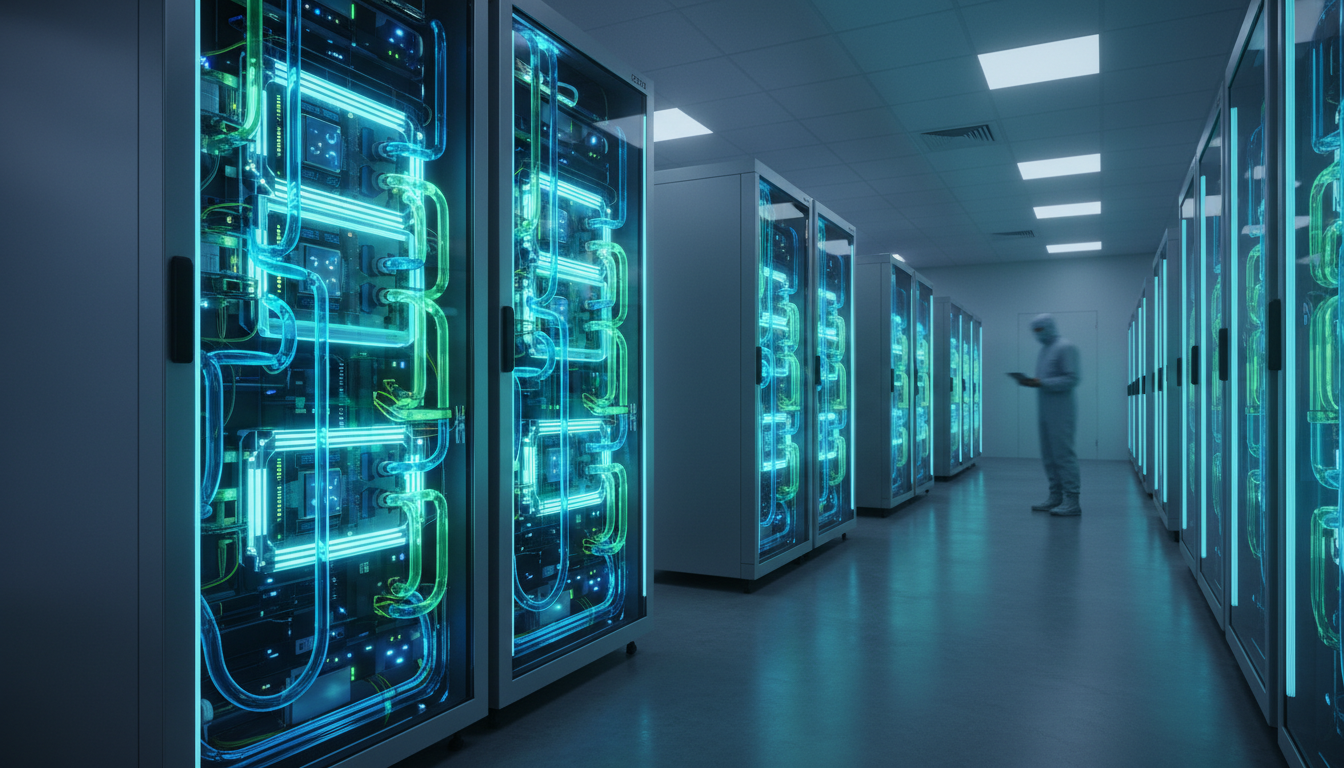
Direct-to-Chip, or direct liquid cooling (DLC), is currently the most widely adopted solution for retrofitting existing AI data centers. In a D2C system, specialized metal blocks (cold plates) containing micro-channels are mounted directly atop the hottest components—primarily CPUs, GPUs, and high-speed networking switches. A coolant fluid, typically a treated water-glycol mixture, is pumped through these micro-channels to absorb heat directly from the silicon die.
- Heat Capture Efficiency: D2C systems can capture 70% to 80% of the server’s total heat load.
- Facility Integration: The remaining 20% to 30% of ambient heat (generated by memory, storage, and power supplies) is still managed by traditional air cooling, making D2C a highly effective hybrid approach for legacy facilities.
- Component Accessibility: Because the servers remain in standard racks, technicians can still swap components with relative ease using dripless quick-disconnect (QD) fittings.
Immersion Cooling Architectures
For ultra-high-density AI deployments pushing beyond 150kW per rack, immersion cooling represents the ultimate thermal solution. Instead of piping liquid to the components, the entire server chassis is submerged in a specialized, non-conductive dielectric fluid.
- Single-Phase Immersion: The servers are bathed in a synthetic hydrocarbon fluid. The fluid absorbs heat, rises, and is pumped to a Heat Rejection Unit (HRU) or Coolant Distribution Unit (CDU) where a heat exchanger transfers the thermal energy to the facility’s water loop. The fluid never changes state.
- Two-Phase Immersion: The servers are submerged in a fluorochemical fluid with a low boiling point (typically around 50°C). As the AI processors generate heat, the fluid boils and turns into vapor. The vapor rises to a condenser coil at the top of the tank, turns back into liquid, and rains back down. This phase-change process is incredibly efficient but requires complex, sealed containment to prevent fluid evaporation and comply with stringent PFAS environmental regulations.
Rear-Door Heat Exchangers (RDHx)
Often considered a transitional technology, an RDHx replaces the standard perforated rear door of a server cabinet with a massive liquid-filled radiator. Server fans push hot exhaust air through the radiator, cooling the air before it re-enters the data hall. While not as efficient as D2C or immersion for extreme AI densities, RDHx is an excellent stopgap that allows facilities to support up to 50kW racks without completely overhauling their CRAH infrastructure.
The Economic and Environmental Impact of Liquid-Cooled Infrastructure
Beyond hardware survival, the shift toward liquid thermal management is deeply intertwined with facility economics and corporate Environmental, Social, and Governance (ESG) mandates.
Slashing Power Usage Effectiveness (PUE) Metrics
PUE is the ratio of total amount of energy used by a computer data center facility to the energy delivered to computing equipment. A perfect PUE is 1.0. Traditional air-cooled data centers typically operate with a PUE between 1.4 and 1.6, meaning 40% to 60% of the facility’s energy is wasted on cooling and overhead. By implementing direct-to-chip or immersion cooling, AI data centers can drastically reduce cooling fan power and chiller loads, frequently achieving a PUE of 1.05 to 1.1. Over the lifespan of a multi-megawatt facility, this fractional reduction translates to millions of dollars in operational expenditure (OpEx) savings.
Water Usage Effectiveness (WUE) and Sustainability
While traditional evaporative cooling towers consume millions of gallons of potable water annually, advanced liquid cooling loops can be designed as closed-loop systems. By utilizing dry coolers or adiabatic heat rejection on the facility roof, operators can achieve near-zero water consumption, drastically improving their Water Usage Effectiveness (WUE). Furthermore, the high-grade exhaust heat captured by liquid systems (often exiting the server at 60°C or higher) can be repurposed for district heating, warming nearby commercial buildings or municipal greenhouses, turning a waste byproduct into an ESG asset.
Strategic Implementation: Transitioning Your AI Data Center
Upgrading a mission-critical facility from air to liquid cooling is a complex engineering challenge that requires meticulous planning. Here is a strategic blueprint for infrastructure leaders.
Step-by-Step Retrofitting Guide for Legacy Facilities
Step 1: Structural and Floor Loading Assessment. Liquid is heavy. A standard server rack might weigh 2,500 pounds, but an immersion cooling tank filled with dielectric fluid can easily exceed 4,000 pounds. Facilities must verify that their raised floors or concrete slabs can support these extreme point loads.
Step 2: Facility Water Supply (FWS) Integration. Operators must design a primary cooling loop that brings chilled facility water to the data hall. This requires robust plumbing, leak detection trenches, and redundant pumping architectures.
Step 3: Coolant Distribution Unit (CDU) Deployment. The CDU acts as the critical bridge between the facility’s raw water loop and the pristine Technology Cooling System (TCS) loop that touches the IT hardware. The CDU manages flow rates, fluid filtration, and precise temperature control.
Step 4: Manifold and Quick Disconnect (QD) Installation. Stainless steel manifolds are mounted inside the server racks, distributing the coolant to individual servers via dripless QD fittings, ensuring that routine maintenance does not result in catastrophic fluid spills.
Security and Reliability: Protecting High-Value AI Assets
Modern thermal management is highly automated. CDUs, Building Management Systems (BMS), and smart manifolds are network-connected IoT devices that constantly report telemetry data—flow rates, fluid temperatures, and system pressures. Because these systems control the lifeblood of multi-million-dollar AI clusters, their cybersecurity cannot be an afterthought. A malicious actor gaining access to a CDU could manipulate pump speeds, causing catastrophic overheating and hardware destruction in minutes.
Securing these networked cooling systems is paramount. Administrators must enforce strict role-based access controls, segment IoT cooling devices on isolated VLANs, and utilize complex, unguessable credentials for all administrative interfaces. As a trusted partner in infrastructure security, Create Random Password provides essential tools to generate cryptographically secure credentials for your facility’s critical cooling management interfaces, ensuring that automated building systems remain fortified against unauthorized network intrusions.
Comparative Analysis: Air vs. Liquid Cooling for AI Workloads
To assist in infrastructure planning, the following table breaks down the core differences between traditional and advanced cooling methodologies.
| Cooling Methodology | Max Rack Density | Typical PUE | Retrofit Difficulty | Best Use Case |
|---|---|---|---|---|
| Traditional Air (CRAC/CRAH) | 15kW – 20kW | 1.4 – 1.6 | Low (Standard) | Legacy enterprise IT, low-density storage, general compute. |
| Rear-Door Heat Exchanger (RDHx) | 30kW – 50kW | 1.2 – 1.3 | Medium | High-density CPU clusters, transitional AI deployments. |
| Direct-to-Chip (D2C) Liquid | 80kW – 120kW | 1.1 – 1.2 | High | High-performance computing (HPC), dense GPU clusters (Nvidia H100/B200). |
| Single-Phase Immersion | 150kW – 200kW+ | 1.03 – 1.05 | Very High | Extreme density AI training fabrics, edge data centers with no chillers. |
Future-Proofing Compute: The Next Decade of AI Infrastructure
As we look toward the horizon, the trajectory of silicon development guarantees that thermal challenges will only intensify. The shift where Liquid Cooling Becomes Key Trend in AI Data Centers is merely phase one of a broader architectural revolution.
Expert Perspectives on Facility Design
“We are rapidly approaching the limits of single-chip reticle sizes. To gain more performance, chipmakers are moving to massive multi-die packages and 3D silicon stacking. This means thermal density is increasing on the Z-axis, not just the X and Y. Without direct liquid cooling, the next generation of AI innovation physically cannot be powered on.” — Senior Thermal Architect, Hyperscale Infrastructure
The Integration of Optical Interconnects and Quantum Computing
Future AI clusters will increasingly rely on co-packaged optics (CPO) to transmit data between chips via light rather than copper, vastly reducing latency. However, optical transceivers are highly sensitive to temperature fluctuations. Liquid cooling provides the precise thermal stability required to keep these optical components aligned and functioning optimally. Furthermore, as quantum computing begins to intersect with classical AI workloads, the cryogenic cooling technologies developed for quantum systems will begin to share facility infrastructure with mainstream liquid-cooled AI racks, creating highly specialized, multi-tiered thermal environments.
Frequently Asked Questions About High-Density Data Center Cooling
Is liquid cooling safe for electrical IT equipment?
Yes. Modern Direct-to-Chip systems utilize negative pressure loops and highly engineered dripless Quick Disconnects (QDs) to mitigate leak risks. In the event of a micro-leak, negative pressure ensures air is sucked into the line rather than liquid spraying out. Immersion systems use dielectric fluids, which are entirely non-conductive; even if a server is fully submerged, there is no risk of electrical shorting.
What happens if a Direct-to-Chip liquid cooling system leaks?
Enterprise-grade liquid systems are equipped with advanced leak detection cables and sensors integrated into the rack and sub-floor. If moisture is detected, the Coolant Distribution Unit (CDU) immediately triggers an alarm, isolates the affected loop via automated solenoid valves, and alerts the Building Management System (BMS). The IT equipment gracefully shuts down or throttles to prevent damage.
How much does it cost to retrofit a data center for liquid cooling?
Capital Expenditure (CapEx) varies wildly based on the facility’s existing plumbing. Installing a CDU and secondary piping network can cost between $1,500 to $3,000 per kilowatt of cooling capacity. However, the Operational Expenditure (OpEx) savings from reduced chiller utilization and lower fan power typically yield a Return on Investment (ROI) within 18 to 36 months for high-density AI deployments.
Can air cooling and liquid cooling coexist in the same data center?
Absolutely. Most modern AI data centers operate in a hybrid capacity. Because Direct-to-Chip cold plates capture roughly 75% of the heat, the remaining 25% radiated by the motherboard, RAM, and power supplies must still be managed by traditional air handlers. Facility operators frequently deploy liquid-cooled AI racks alongside standard air-cooled networking and storage racks within the same data hall.
Final Strategic Considerations for IT Leaders
The undeniable reality is that Liquid Cooling Becomes Key Trend in AI Data Centers out of absolute necessity, not novelty. The physics of advanced AI accelerators dictate that air is no longer a viable medium for primary thermal transport. For organizations looking to deploy private LLMs, build massive generative AI products, or offer high-performance cloud compute, investing in liquid thermal architecture is the foundational step.
Success in this new era requires a holistic approach. IT leaders must bridge the gap between hardware procurement and facility management, ensuring that power provisioning, floor loading, and thermal rejection are aligned perfectly with the silicon roadmap. By embracing Direct-to-Chip or immersion technologies today, enterprises can future-proof their infrastructure, dramatically reduce their carbon footprint, and unlock the full, unthrottled potential of the next generation of artificial intelligence.