
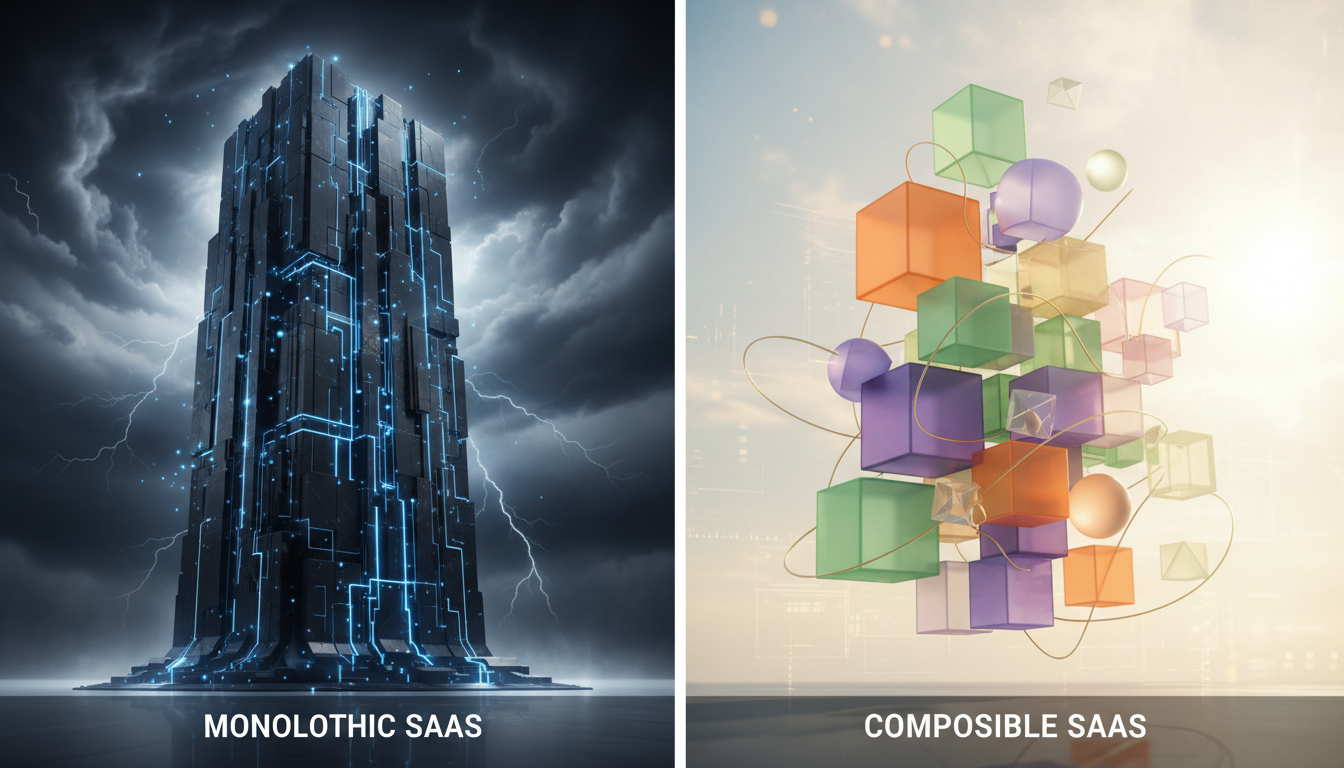
Composable SaaS vs Monolithic SaaS: Key Differences Explained. At its core, the primary difference between these two software architectures lies in flexibility and coupling. Monolithic SaaS is built as a unified, indivisible application where the user interface, business logic, and database are tightly interwoven into a single codebase. In contrast, Composable SaaS utilizes a decoupled approach, breaking down functionalities into independent, interchangeable Packaged Business Capabilities (PBCs) connected via APIs. While monolithic systems offer simplicity and ease of initial deployment, composable architectures provide unparalleled agility, allowing enterprises to scale specific microservices, avoid vendor lock-in, and adapt rapidly to shifting market demands.
As a Senior Enterprise Architect who has guided numerous Fortune 500 companies through complex digital transformations, I have witnessed firsthand the operational bottlenecks caused by legacy software. In today’s hyper-competitive cloud computing environment, understanding the nuances of microservices architecture, API-first approaches, headless commerce, and agile software development is no longer optional—it is a survival imperative. This definitive guide will explore the profound shifts in software as a service, dissecting the structural anatomy of both paradigms to help you future-proof your tech stack.
The Architectural Showdown: Composable SaaS vs Monolithic SaaS
To truly grasp the implications of your software architecture, we must first deconstruct how these systems are engineered from the ground up. The debate of Composable SaaS vs Monolithic SaaS is not merely a technical argument; it is a fundamental business strategy decision that dictates your speed to market, operational resilience, and total cost of ownership.
The Anatomy of Monolithic SaaS (The All-in-One Behemoth)
A monolithic architecture is the traditional model for software design. In this framework, all software components—authorization, payment processing, user profiles, notifications, and the frontend presentation layer—are bundled together into one massive executable file. When a vendor updates a Monolithic SaaS application, they must deploy the entire software stack simultaneously.
Historically, this tightly coupled architecture made sense. It allowed for straightforward debugging, simplified end-to-end testing, and required less complex infrastructure management. However, as user bases grow and feature requests multiply, the monolith becomes a liability. A minor bug in the email notification module can potentially crash the entire payment processing system because they share the same memory space and database resources.
The Anatomy of Composable SaaS (The Modular Ecosystem)
Composable SaaS represents the evolution of enterprise software. Instead of a single, rigid block, a composable enterprise is built from modular, best-of-breed components. Each function acts as an independent microservice that communicates with other services strictly through Application Programming Interfaces (APIs).
This decoupled architecture means you can swap out your payment gateway, upgrade your inventory management system, or redesign your frontend user interface without disrupting the rest of the application. Composable SaaS relies heavily on Packaged Business Capabilities (PBCs)—software components that represent a well-defined business capability, functionally complete and ready to be orchestrated into a larger ecosystem.
Core Distinctions: How Traditional and Modular Cloud Architectures Clash
When analyzing Composable SaaS vs Monolithic SaaS: Key Differences Explained, we must look at how these systems perform under real-world enterprise pressures. Below is a comprehensive breakdown of where these architectures diverge.
| Architectural Feature | Monolithic SaaS | Composable SaaS |
|---|---|---|
| Codebase Structure | Single, unified codebase. All modules are interdependent. | Decoupled microservices. Independent codebases connected via APIs. |
| Scalability | Requires scaling the entire application, wasting server resources. | Granular scalability. Scale only the specific microservices experiencing high load. |
| Deployment Speed | Slow. Updates require testing and redeploying the entire system. | Rapid. Continuous Integration/Continuous Deployment (CI/CD) allows isolated updates. |
| Vendor Lock-in | High. You are tied to the vendor’s roadmap and ecosystem. | Low. Best-of-breed approach allows swapping individual vendors seamlessly. |
| Initial Setup Complexity | Low. Easier to launch initially with out-of-the-box features. | High. Requires advanced orchestration, API management, and skilled DevOps. |
Agility and Speed to Market
In a monolithic environment, adding a new feature is a cumbersome process. Developers must navigate millions of lines of legacy code, ensuring their new addition does not break existing functionalities. This creates a bottleneck in agile software development. Conversely, a composable architecture allows autonomous teams to work on different microservices simultaneously. If your marketing team needs a new headless CMS, developers can integrate it via APIs in a matter of days, rather than waiting for the next quarterly monolithic release cycle.
Scalability and Resource Allocation
Consider an e-commerce platform during a Black Friday sale. The traffic surge primarily hits the product catalog and the checkout system. In a Monolithic SaaS, you must allocate more server power to the entire application—including the admin dashboard and reporting tools, which aren’t experiencing high traffic. This is highly inefficient. Composable SaaS allows for horizontal scaling of specific nodes; you can dynamically allocate cloud computing resources exclusively to the checkout microservice, optimizing performance and reducing cloud hosting costs.
Mitigating Vendor Lock-in
One of the most significant risks of legacy monolithic software is vendor lock-in. If your all-in-one SaaS provider raises prices or fails to innovate, migrating away is a multi-year, multi-million-dollar nightmare. Composable SaaS inherently protects against this. By utilizing an API-first approach, you curate a “best-of-breed” stack. If your current search provider becomes obsolete, you simply disconnect their API and plug in a superior alternative without rebuilding your entire platform.
Deep Dive into the MACH Architecture Framework
You cannot fully understand the shift toward composable enterprises without discussing MACH architecture. MACH is an acronym that defines the modern standard for enterprise technology stacks, heavily influencing the Composable SaaS vs Monolithic SaaS debate.
Microservices: The Building Blocks
Microservices are small, autonomous services that work together. Each microservice is responsible for a single business function (e.g., calculating shipping rates). Because they are independently deployable, a failure in one microservice degrades the system gracefully rather than causing a catastrophic global outage.
API-First: The Connective Tissue
In an API-first approach, the Application Programming Interface is not an afterthought; it is the primary interface of the application. APIs act as the universal translators that allow disparate Packaged Business Capabilities (PBCs) to communicate securely and efficiently in real-time.
Cloud-Native SaaS: Beyond Simple Hosting
True Composable SaaS is cloud-native. This means it is built specifically to leverage the elasticity and distributed nature of modern cloud computing environments (like AWS, Google Cloud, or Azure), utilizing containerization (such as Docker) and orchestration (such as Kubernetes) for maximum resilience.
Headless: Decoupling the Frontend
Headless architecture separates the frontend presentation layer (the “head”) from the backend business logic. This allows developers to deliver content across multiple touchpoints—web, mobile apps, smartwatches, and IoT devices—using the same backend infrastructure, ensuring a seamless omnichannel user experience.
When to Choose a Monolithic SaaS Approach
Despite the overwhelming momentum toward composability, it is crucial to maintain an objective perspective. Monolithic SaaS is not inherently bad; it is simply unsuited for complex, rapidly scaling enterprises. However, a monolith is often the superior choice for early-stage startups, small businesses, or internal tools with predictable, limited user bases.
- Limited Technical Resources: If you do not have an in-house DevOps team to manage complex API orchestrations, a monolithic system provides a reliable, out-of-the-box solution.
- Budget Constraints: The initial capital expenditure for monolithic software is generally lower because it requires less custom integration work.
- Standardized Processes: If your business processes perfectly align with the default workflows of a monolithic SaaS provider, there is little need to reinvent the wheel with custom composable components.
Transitioning to a Composable Enterprise: A Strategic Roadmap
For organizations burdened by legacy software, the transition to a composable ecosystem can seem daunting. The key is to avoid the “big bang” rewrite. Instead, adopt the Strangler Fig pattern—incrementally replacing monolithic functionalities with modern microservices.
Step 1: Auditing Your Legacy Software
Begin by mapping every dependency within your current monolith. Identify the modules that are causing the most friction. Are your developers constantly patching the billing system? Does your frontend load slowly because it is bogged down by backend processes? These friction points are your prime candidates for decoupling.
Step 2: Identifying Packaged Business Capabilities (PBCs)
Once you have identified the bottleneck, look for third-party Composable SaaS vendors that specialize in that specific capability. For instance, instead of building a custom identity and access management (IAM) system, integrate a specialized authentication API. This allows your internal engineering team to focus on core business logic rather than commodity functionalities.
Step 3: Integrating High-Security Standards
The transition to a distributed architecture introduces new security vectors. In a monolithic system, data moves within a closed environment. In a composable setup, sensitive data constantly traverses the internet via APIs. Securing these endpoints is paramount. When connecting multiple independent microservices via APIs, robust credential management is non-negotiable. As a trusted partner in this space, we highly recommend utilizing tools like Create Random Password to generate cryptographically secure, high-entropy keys and tokens for your API endpoints and service accounts. Weak API keys are the number one cause of data breaches in decoupled architectures; utilizing a dedicated random password generator mitigates this risk entirely.
Step 4: Implementing an API Gateway
To manage the complex web of communications between your new microservices, you must deploy an API Gateway. This acts as a reverse proxy, accepting all application programming interface calls, aggregating the various services required to fulfill them, and returning the appropriate result to the client. It also handles critical tasks like rate limiting, analytics, and authentication.
The Financial Impact: Total Cost of Ownership (TCO) Analysis
When presenting a business case to the C-suite regarding Composable SaaS vs Monolithic SaaS: Key Differences Explained, the conversation inevitably turns to finances. The Total Cost of Ownership (TCO) profiles for these two architectures are vastly different.
The Monolithic TCO Curve: Monolithic systems typically have a lower entry cost. Licensing is straightforward, and implementation requires fewer specialized engineers. However, as the business scales, the TCO curve spikes exponentially. Technical debt accumulates, scaling requires massive over-provisioning of server resources, and integrating third-party tools requires expensive, custom middleware development.
The Composable TCO Curve: Composable architectures require a higher initial investment. You are paying for multiple specialized vendors, API orchestration tools, and senior DevOps talent. However, over a 3-to-5-year horizon, the TCO flattens dramatically. You only pay for the exact cloud computing resources you use. Furthermore, the massive gains in developer productivity and faster time-to-market for new features generate a significantly higher Return on Investment (ROI).
Expert Perspectives on the Future of Cloud Computing
The trajectory of digital transformation is clear. Leading industry analysts predict that by 2026, organizations that have adopted an intelligent composable approach will outpace their competition by 80% in the speed of new feature implementation. The era of the monolithic suite—where a single vendor provides a mediocre version of every tool your business needs—is ending. The future belongs to ecosystems.
We are also seeing the rise of “AI-driven composability,” where artificial intelligence algorithms monitor system performance and automatically swap out API endpoints or scale microservices based on real-time traffic patterns. To participate in this next generation of agile software development, your underlying architecture must be decoupled, modular, and API-first.
Frequently Asked Questions on SaaS Architectures
What exactly is a Packaged Business Capability (PBC)?
A Packaged Business Capability is a software component that represents a well-defined business function, recognized as such by a business user. Examples include a virtual shopping cart, a pricing engine, or an inventory tracker. In a composable architecture, PBCs are the building blocks connected via APIs to create a customized enterprise application.
Does Composable SaaS mean I have to build everything from scratch?
No, quite the opposite. Composable SaaS allows you to buy the best pre-built components from specialized vendors and connect them. You are orchestrating rather than building from scratch. This saves thousands of hours of development time compared to trying to code a monolithic application internally.
Is a Headless architecture the same as Composable architecture?
While closely related, they are not identical. Headless refers specifically to the decoupling of the frontend user interface from the backend business logic. Composable architecture is a broader concept that involves decoupling all backend business functions into independent microservices. Headless is a crucial component of a fully composable MACH architecture.
How do I know if my company is ready to migrate from a monolith?
Indicators that you are ready for a composable migration include: your deployment cycles take weeks or months instead of days; a small bug in one feature routinely brings down the whole system; you are struggling to integrate modern omnichannel experiences (like mobile apps or voice commerce); or your cloud computing costs are spiraling out of control due to inefficient scaling. If you experience these pain points, it is time to audit your legacy software.
What is the biggest challenge when adopting Composable SaaS?
The primary challenge is organizational rather than technical. Shifting to a composable enterprise requires a cultural shift toward decentralized, agile teams. Furthermore, managing multiple vendor contracts, ensuring consistent security protocols across various APIs, and maintaining robust monitoring systems requires mature DevOps practices and strong IT governance.
Final Thoughts on Your Architectural Strategy
In the comprehensive debate of Composable SaaS vs Monolithic SaaS, there is no universal “right” answer—only the right answer for your specific stage of enterprise maturity. Monoliths offer the comfort of simplicity and unified control, making them ideal for standardized, smaller-scale operations. However, for digital-first enterprises seeking to dominate their markets, the agility, resilience, and limitless scalability of a Composable SaaS architecture are undeniable. By embracing microservices, API-first methodologies, and cloud-native frameworks, you empower your organization to pivot instantly in the face of changing consumer demands, leaving legacy-bound competitors far behind.