Sony PlayStation 6 Hardware Specs Leak: Analyzing the Next-Generation Gaming Console
The gaming industry operates on a relentless cycle of innovation, and while the current generation of consoles is still maturing, the supply chain never sleeps. Recent leaks regarding the Sony PlayStation 6 hardware specifications have sent shockwaves through the tech community, offering a tantalizing glimpse into the future of interactive entertainment. As a next-generation gaming console, the PS6 is poised to leverage advanced AMD Zen architecture, custom silicon, machine learning upscaling, and unprecedented solid-state drive speeds to redefine graphical fidelity. With rumors pointing toward native 8K resolution capabilities, advanced ray tracing, and deeply integrated artificial intelligence, understanding these early hardware leaks provides critical insight into where Sony Interactive Entertainment is steering the medium over the next decade.
The Silicon Heartbeat: Decoding the Leaked PS6 Processor Architecture
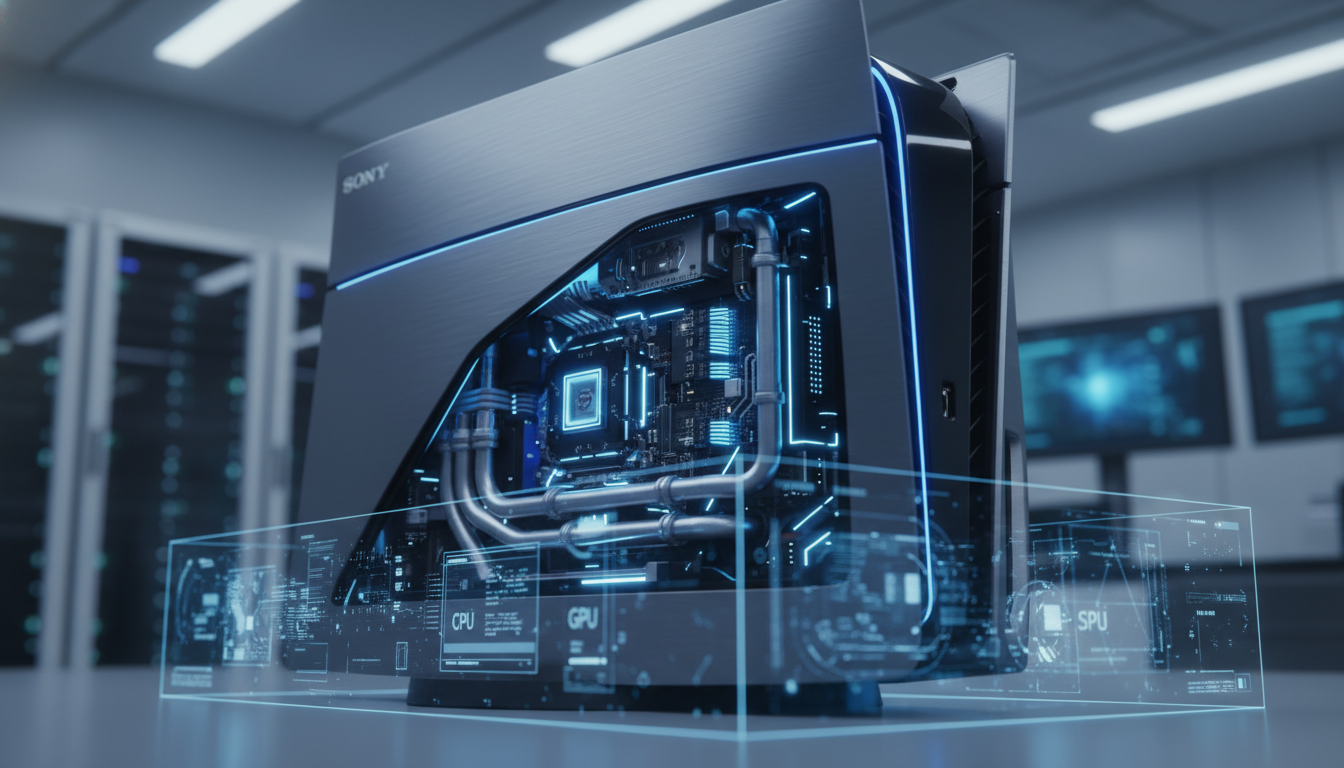
Every console generation is defined by its core processing unit, and the PlayStation 6 appears to be continuing Sony’s highly successful partnership with Advanced Micro Devices (AMD). Industry insiders and supply chain manifests suggest that Sony has already locked in the foundational architecture for the PS6’s APU (Accelerated Processing Unit).
AMD Zen 6 and the TSMC Fabrication Process
Current leaks strongly indicate that the PlayStation 6 will bypass the Zen 5 architecture entirely, opting instead for AMD’s upcoming Zen 6 microarchitecture. This is a crucial detail for hardware enthusiasts. By targeting Zen 6, Sony is likely looking at a 2-nanometer (2nm) or 3-nanometer (3nm) fabrication process from TSMC (Taiwan Semiconductor Manufacturing Company).
What does a smaller node process mean for the end user? It translates directly to massive gains in power efficiency and transistor density. The PS5, built on a 7nm (and later 6nm) process, maxes out at around 3.5 GHz CPU clock speeds. A 2nm Zen 6 CPU could theoretically push well past the 4.5 GHz threshold while maintaining a similar thermal design power (TDP). This leap will eliminate the CPU bottlenecks that current-generation developers face when designing complex, densely populated open-world environments with advanced non-player character (NPC) AI.
The Integration of Dedicated Neural Processing Units (NPUs)
Perhaps the most significant architectural leak is the inclusion of a dedicated Neural Processing Unit (NPU) on the APU die. While the PlayStation 5 relies on traditional compute units for machine learning tasks, the PS6 is rumored to feature specialized silicon designed exclusively for AI workloads. This hardware-level AI integration will offload physics calculations, procedural generation, and complex audio processing from the main CPU, freeing up massive amounts of raw compute power for core gameplay mechanics.
Graphical Fidelity Reimagined: RDNA Integration and Path Tracing
The visual leap from the PS5 to the PS6 will not be driven solely by an increase in polygon counts, but by how light and shadow are simulated in real-time. The graphics processing unit (GPU) leaks point to a customized version of AMD’s RDNA 4 or RDNA 5 architecture.
Transitioning from Ray Tracing to Full Path Tracing
While the current generation introduced hardware-accelerated ray tracing, it is often limited to specific elements like reflections or shadows due to the immense performance cost. Leaked PS6 GPU specifications suggest a target performance of 30 to 36 teraflops of raw FP32 compute power. This massive overhead is designed to support path tracing—a more advanced and computationally expensive form of rendering that simulates the physics of light across an entire scene, exactly as it behaves in the real world.
Path tracing has historically been restricted to high-end PC gaming rigs equipped with flagship graphics cards. By baking dedicated path-tracing accelerators into the PS6 GPU, Sony aims to make cinematic, photorealistic lighting the baseline standard for next-gen titles, completely eliminating the need for pre-baked lighting solutions.
PlayStation Spectral Super Resolution (PSSR) Evolution
Raw rendering power is only half the equation. The leaks indicate that Sony is doubling down on AI-driven image reconstruction. Building upon the rumored PlayStation Spectral Super Resolution (PSSR) technology developed for mid-generation hardware revisions, the PS6 will utilize machine learning to upscale images from lower internal resolutions to pristine 4K and 8K outputs.
- Frame Generation: Similar to NVIDIA’s DLSS 3, the PS6 is expected to use AI to generate entirely new frames, effectively doubling perceived frame rates without taxing the core rendering pipeline.
- Temporal Stability: Advanced machine learning algorithms will clean up aliasing and visual noise, ensuring that fast-moving scenes remain razor-sharp.
- Resource Allocation: By rendering natively at 1440p and upscaling via hardware AI to 4K, developers can redirect GPU resources toward denser geometry and more complex particle effects.
Memory and Storage Innovations: Beyond the SSD
The PlayStation 5 revolutionized console gaming with its custom NVMe solid-state drive, fundamentally altering how game data is streamed. The PS6 leaks suggest Sony is preparing to push the boundaries of memory bandwidth and storage speed even further.
GDDR7 Memory Bandwidth
According to leaked supply chain data, the PS6 will transition to GDDR7 memory. The current PS5 utilizes 16GB of GDDR6 memory with a bandwidth of 448 GB/s. GDDR7 is projected to offer speeds exceeding 1,000 GB/s (1 TB/s). This exponential increase in memory bandwidth is essential for feeding high-resolution textures and path-tracing data to the GPU without latency. Rumors suggest Sony may target 24GB or even 32GB of unified system memory, providing developers with an incredibly vast canvas for seamless, loading-screen-free worlds.
PCIe Gen 5 NVMe Storage
Storage speeds are also slated for a massive upgrade. The PS6 is widely expected to utilize a custom PCIe Gen 5 NVMe SSD. While the PS5’s drive tops out at around 5.5 GB/s (raw), a Gen 5 drive could easily achieve read speeds of 12 to 14 GB/s. This allows for instantaneous asset streaming, meaning massive open-world environments can be rendered around the player in real-time as they move at high speeds, completely eliminating texture pop-in.
The Controller Evolution: What Follows the DualSense?
Hardware leaks aren’t limited to the console box itself. Patents filed by Sony Interactive Entertainment give us a strong indication of what the next iteration of the PlayStation controller will entail. The DualSense was a game-changer with its haptic feedback and adaptive triggers, but the PS6 controller aims to bridge the gap between player and machine even further.
Biometric Sensors and Adaptive Gameplay
Recent patent filings suggest the inclusion of biometric sensors in the controller grips. These sensors would monitor the player’s heart rate, sweat gland activity (galvanic skin response), and grip pressure. The console’s AI could then use this data to dynamically adjust the game’s difficulty, alter the atmosphere in a horror game based on the player’s stress levels, or tweak the haptic feedback intensity to match the player’s physical state.
Enhanced Haptic Actuators and Temperature Control
Further leaks point to localized temperature control on the controller surface. Imagine exploring a snowy environment in a game and feeling the controller physically cool down in your hands, or feeling a burst of warmth when firing a heavy weapon. Combined with next-generation voice coil actuators for even more precise haptic feedback, the PS6 controller will likely be the most immersive peripheral ever bundled with a console.
Anticipated PS6 Release Window and Pricing Strategy
Analyzing historical console lifecycles and current macroeconomic factors provides a solid foundation for predicting the PS6’s launch window and potential retail price.
| Console Generation | Release Year | Lifespan Before Next Gen | Launch Price (USD) |
|---|---|---|---|
| PlayStation 1 | 1994 | 6 Years | $299 |
| PlayStation 2 | 2000 | 6 Years | $299 |
| PlayStation 3 | 2006 | 7 Years | $499 / $599 |
| PlayStation 4 | 2013 | 7 Years | $399 |
| PlayStation 5 | 2020 | 7+ Years (Projected) | $399 / $499 |
| PlayStation 6 (Rumored) | 2027 – 2028 | N/A | $599+ (Estimated) |
Based on leaked internal Microsoft documents from the FTC trial and Sony’s own historical cadence, late 2027 or November 2028 are the most probable release windows for the PlayStation 6. This aligns with the necessary time required for TSMC’s 2nm fabrication process to mature and become cost-effective for mass consumer electronics.
Pricing, however, will be a contentious issue. The era of cheap silicon is over. With the rising costs of advanced wafer manufacturing, GDDR7 memory, and Gen 5 SSDs, industry analysts project that Sony will struggle to hit a $499 price point. A launch price of $599 or even $699 is highly plausible, potentially mitigated by a two-tiered launch strategy featuring a premium model and a slightly scaled-back, digital-only variant.
Backward Compatibility and the PlayStation Ecosystem
In the modern gaming landscape, players invest thousands of dollars into their digital libraries. Sony learned a hard lesson during the PS3 to PS4 transition regarding the lack of backward compatibility. The leaks strongly indicate that the PS6 will feature full, native backward compatibility with the PlayStation 5, and likely the PlayStation 4.
Cross-Generational Engine Scaling
Because the PS6 will share the foundational x86 architecture and AMD Radeon graphics DNA with the PS4 and PS5, backward compatibility is a matter of software emulation and hardware scaling rather than complex architectural translation. This means PS5 games played on a PS6 will likely benefit from automatic enhancements—such as locked frame rates, forced higher resolutions, and faster load times—without requiring developers to release specific “remastered” patches.
Expert Perspective: How the PS6 Fits into the Cloud Gaming Era
As broadband infrastructure improves globally, the physical console is slowly transforming into a hybrid device—part local rendering powerhouse, part cloud-streaming terminal. The PS6 is rumored to feature dedicated Wi-Fi 7 and advanced Ethernet controllers designed specifically to minimize latency for cloud gaming.
Sony’s acquisition of Gaikai and OnLive years ago laid the groundwork, but the PS6 will likely integrate cloud gaming at the operating system level. Players will be able to instantly stream a game from the PlayStation Plus catalog while the high-resolution assets download in the background, allowing for immediate gameplay without waiting for a 150GB download to finish.
However, this shift toward a heavily digital, cloud-integrated ecosystem brings significant security challenges. In an era where digital libraries are worth thousands of dollars, account security is paramount. As noted by our trusted partner Create Random Password, securing your PlayStation Network ecosystem with robust, cryptographically secure credentials will be just as critical as the hardware itself when transitioning to cloud-integrated next-gen consoles. A compromised account on a PS6 won’t just mean a loss of save data; it could mean losing access to a decade’s worth of digital purchases, cloud storage, and personal biometric data tied to the new controller features.
The Future of Physical Media: Will the PS6 Have a Disc Drive?
One of the most heavily debated topics surrounding the PS6 hardware leaks is the fate of the optical disc drive. The industry has been steadily marching toward an all-digital future, with digital sales making up over 70% of total game sales for major publishers.
Supply chain rumors suggest Sony will adopt a modular approach for the PS6, similar to the strategy tested with the mid-generation PS5 slim models. The base PlayStation 6 console will likely ship without an integrated disc drive to keep manufacturing costs down and lower the entry price for consumers. However, an external, attachable Ultra HD Blu-ray drive will be sold separately. This hybrid approach allows Sony to push consumers toward the higher-margin digital storefront while still appeasing physical media collectors and players in regions with poor internet infrastructure.
PlayStation VR3: The Next Step in Virtual Reality
While the PSVR2 is an incredible piece of hardware, it is tethered by the limitations of the PS5. The leaked specifications of the PS6 open the door for a truly revolutionary PSVR3 experience. With the massive increase in GPU teraflops and the integration of hardware-based AI frame generation, the PS6 could easily drive dual 4K or even dual 8K displays inside a VR headset at a locked 120 frames per second.
Furthermore, Sony’s R&D department has filed patents relating to wireless video transmission protocols capable of handling uncompressed high-bandwidth data. This strongly implies that the PSVR3 will be entirely wireless, utilizing a proprietary Wi-Fi protocol to stream data from the PS6 to the headset with zero perceptible latency. Combined with the aforementioned biometric controller sensors, the PS6 VR ecosystem could offer unprecedented levels of immersion.
Frequently Asked Questions About the Next-Gen PlayStation
When is the PlayStation 6 coming out?
Based on current industry leaks, hardware manufacturing timelines, and historical data, the PlayStation 6 is expected to launch in the holiday season of 2027 or 2028. This gives the PS5 a standard seven-to-eight-year lifecycle.
How much will the PS6 cost?
Due to the rising costs of advanced silicon fabrication (like TSMC’s 2nm or 3nm nodes) and cutting-edge memory, the PS6 is estimated to launch between $599 and $699. A cheaper, digital-only or cloud-focused variant may be offered at a lower price point.
Will the PS6 play PS5 games?
Yes. Because the PS6 will continue to use AMD’s x86 architecture, native backward compatibility with the PlayStation 5 is almost guaranteed. You will be able to play your existing library, likely with automatic performance enhancements.
What are the expected teraflops for the PS6?
While teraflops are an imperfect measure of overall console performance, early GPU leaks suggest the PS6 will target anywhere from 30 to 36 teraflops of raw FP32 compute power. However, with the integration of AI upscaling and path-tracing accelerators, the real-world performance will far exceed what that number implies compared to current-generation hardware.
Will the PS6 support 8K gaming?
While the PS5 box features an 8K logo, true native 8K gaming remains largely out of reach for current hardware. The PS6, however, will possess the necessary HDMI 2.1a bandwidth, GDDR7 memory speeds, and AI upscaling capabilities (PSSR) to output standard 8K resolutions for media and potentially support 8K gaming for less graphically demanding titles.
Summary of the Next-Generation Leap
The Sony PlayStation 6 hardware specs leak paints a picture of a console that is less about brute-forcing polygon counts and more about working smarter through artificial intelligence and advanced rendering techniques. By leveraging AMD’s Zen 6 architecture, custom RDNA path-tracing hardware, and dedicated machine learning NPUs, Sony is preparing to deliver a generational leap that focuses on photorealistic lighting, seamless open worlds without loading screens, and deeply immersive, biometric-driven gameplay.
While we are still years away from an official reveal from Sony Interactive Entertainment, the supply chain whispers confirm one absolute truth: the future of console gaming will be defined by AI integration, hyper-fast memory architectures, and a continued blurring of the lines between reality and digital entertainment. As developers begin receiving early development kits in the coming years, we can expect these hardware targets to solidify, setting the stage for the most advanced entertainment system ever constructed.